
Client: co2online, BMUV & UBA
5 × 3:30 min & 4 × 3:15 min | Germany | 2024 | 16:9 | 4K

The ‘Blue Compass 2024’ is the most important award in Germany in the field of climate mitigation and adaptation. The prize, worth 25,000 euros, is awarded each year by the Federal Ministry for the Environment (BMUV) and the Federal Environment Agency (UBA) for projects aimed at preventing and adapting to the consequences of climate change.
In addition to the prize money, a portrait film is also intended to help the winners gain more visibility. For the film series, five portrait films were therefore to be made about the award winners in the four categories: 1) municipalities, 2) private and municipal companies, 3) research and educational institutions and 4) clubs, associations and foundations. A fifth film was made about the winner of the Audience Award.
The films in the five-part series were to be given a serial character through a uniformly designed intro, outro and belly bands, but were to be able to stand on their own. The aim of the films was to encourage viewers and encourage them to follow suit. To this end, the people responsible for the project should be closely followed by the camera. The filming locations, protagonists and the catalogue of questions for the five projects were precisely coordinated in advance with the BMUV, the Federal Environment Agency and our client co2online.

EPISODE 1/5 | CITY OF GOETTINGEN AND GOETTINGEN WASTE DISPOSAL COMPANY
EPISODE 2/5 | INVENTIED GMBH
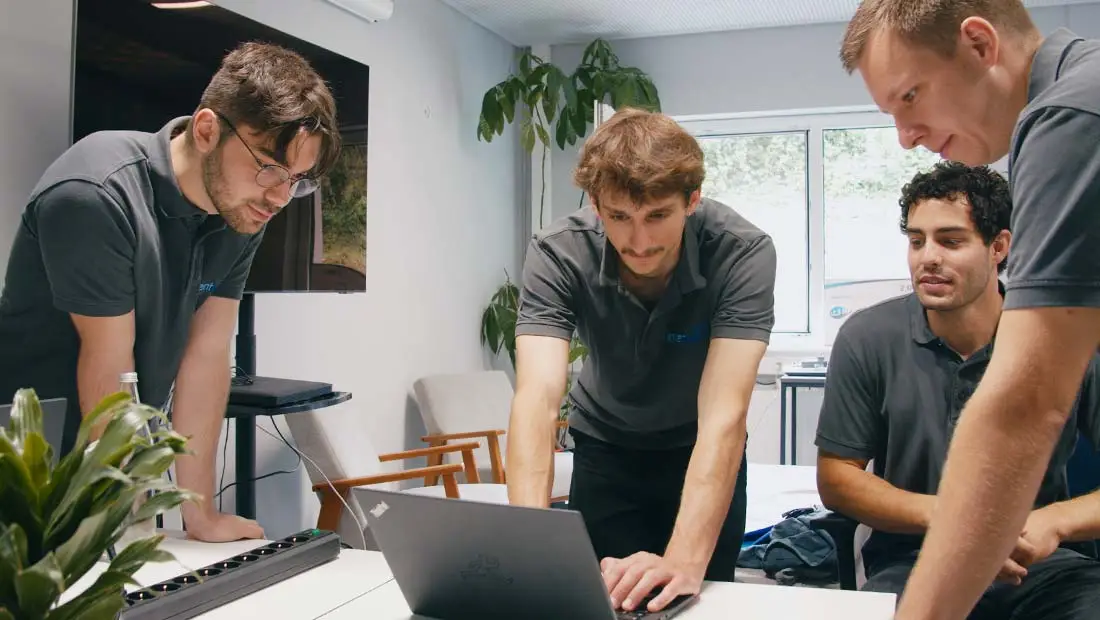
EPISODE 3/5 | BÄR MEETS ADLER E.V.
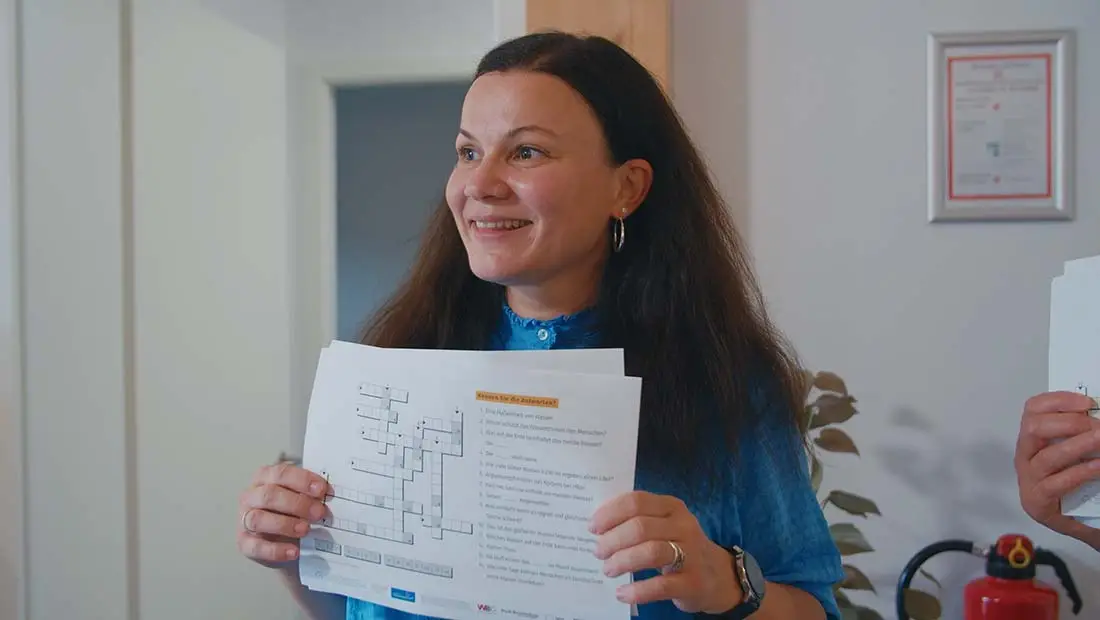
EPISODE 4/5 | UNIVERSITY OF STUTTGART / TECHNOLOGIE-TRANSFER-INITIATIVE GMBH
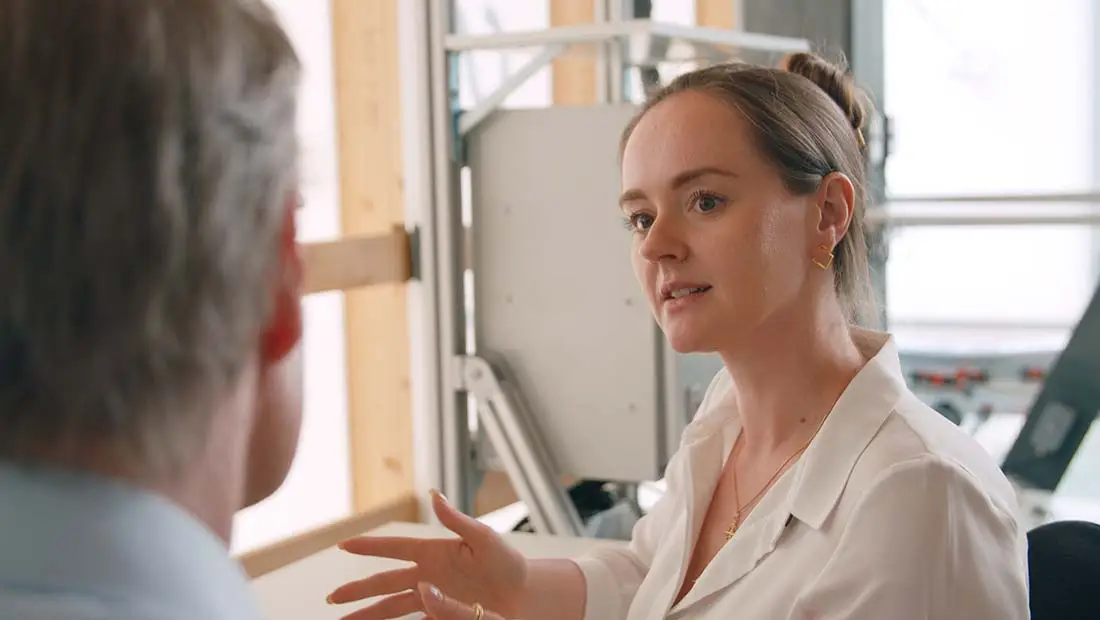
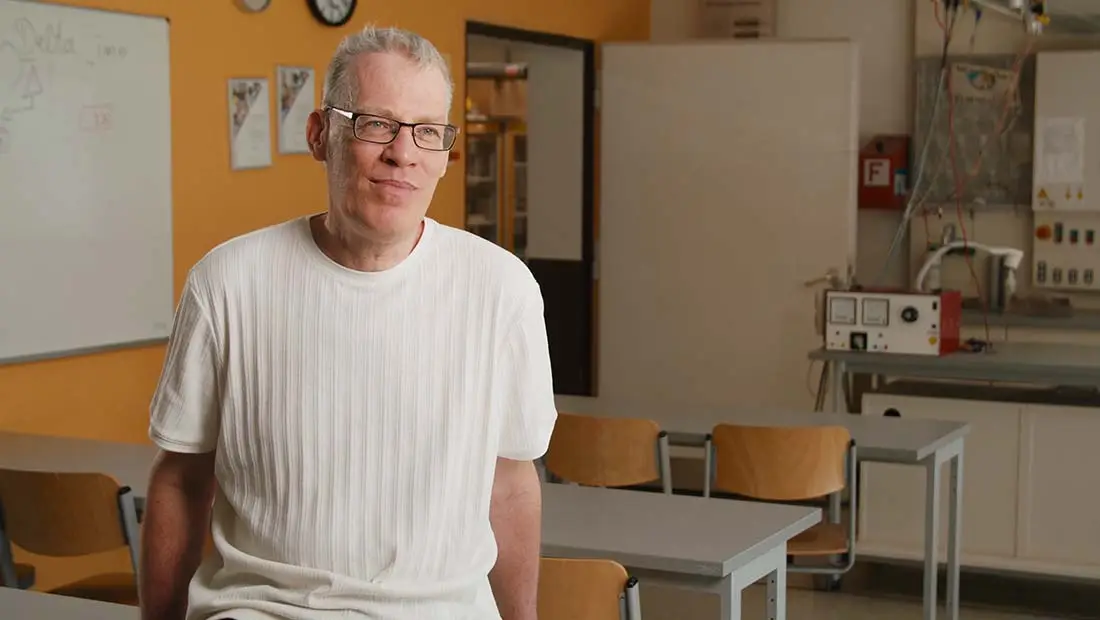
EPISODE 5/5 | LEIBNIZ-GYMNASIUM DORMAGEN
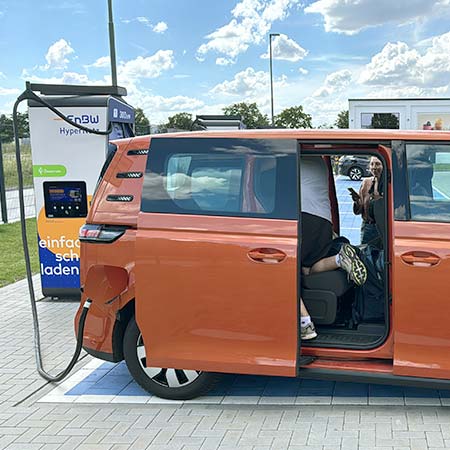
The film was shot with a team consisting of director, camera and camera assistant. As a green film production, we are naturally interested in travelling as resource-efficiently as possible. That's why we drove the entire 3200 kilometres we had to cover for our shoot in a VW ID. Buzz. This required us to plan charging stops at fast-charging stations along the motorway in advance and include them in the filming process.
One challenge was to plan five projects at different locations in Germany as efficiently as possible. The first filming block therefore travelled from Berlin to Dormagen, then on to Rockenhausen and finally back to Berlin via Brandenburg. To save resources, the shoot in Stuttgart was combined with another of our film projects during this time. We travelled to Göttingen separately from Berlin.
Professional camera technology in 4K, a camera gimbal for moving shots and tracking shots, as well as energy-saving LED lighting technology were used for the filming. A drone was also used to capture aerial perspectives in 4K to provide viewers with an overview of the locations.The production process for all films was carried out with extensive consideration of social, economic and ecological sustainability. The film production was 100 per cent climate-neutral. This was ensured by our Green Film Consultant Sarah, who was specially trained in green film shooting and who calculated the CO₂ emissions for this film project and compiled a final report.
After shooting, the film footage was processed into finished films in post-production by our editors Moritz and Arda. The intro and outro in 3D space and the belly bands were graphically designed and then animated by our animation designer Cristian, taking into account the Blue Compass corporate design. The colour grading of all films was carried out by our colourist Marcus in a professional colour grading studio. One of the challenges here was to harmonise the different lighting moods of a film location when the light changed. Nevertheless, each of the five portrait films was to be given an individual style.


On the sound level, our sound mixer Alex optimised the interview sequences and the music. Alex created an atmospheric sound design for the five films with natural soundscapes of nature and interiors.
The five-part portrait film series was presented for the first time at the award ceremony in autumn 2024 at the Federal Ministry for the Environment in Berlin. The films were also published on the website and social media channels of the BMUV, UBA and the award winners.


